
 Editorial Team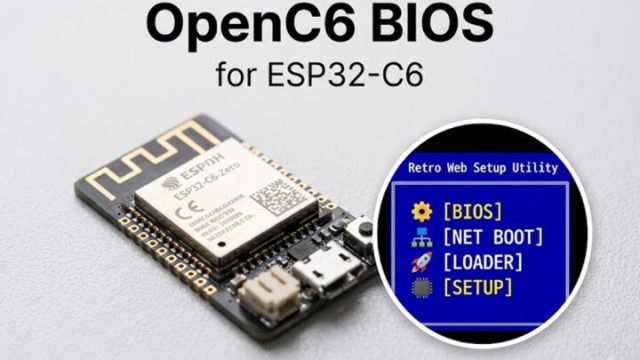
Revolutionizing MCU Development: OpenC6 BIOS for ESP32-C6
The technological landscape is rapidly changing, especially in the realm of microcontroller units (MCUs). With the introduction of OpenC6 BIOS, developed by Rompass, developers are now witnessing a significant shift in how firmware is managed and utilized on the ESP32-C6 microcontroller. This pioneering project introduces a PC-like BIOS system, allowing for more efficient hardware management and application development.
The Traditional vs. the Innovative Approach
Conventionally, MCU firmware development combines the hardware setup, networking elements, and application code into a single, monolithic firmware image. This approach can be limiting, especially when it comes to updating applications or managing hardware dependencies. However, OpenC6 BIOS takes a different stance by offering a modular framework. This innovation allows the operating system layer to function independently from the application code.
Benefits of OpenC6 BIOS
- Separation of Concerns: By decoupling system functions and application code, developers can focus on individual components without worrying about the entire firmware.
- Dynamic Loading: The BIOS allows for small payload programs to be loaded into the system, which can either run from RAM or utilize flash memory for execution.
- Enhanced OTA Updates: With this new architecture, Over-The-Air (OTA) updates become simpler and more efficient, saving time and resources.
How Does OpenC6 BIOS Work?
The OpenC6 BIOS functions as a foundational system that initializes hardware and manages system functions. Here's a brief overview of its functionality:
Modular System Architecture
Instead of requiring the entire firmware to be flashed every time a small update is needed, OpenC6 BIOS allows users to flash just the payloads. This modular system architecture comes with significant advantages:
- Reduced Flashing Time: Since only small updates are needed, the process is much quicker.
- Increased Flexibility: Developers can test and deploy changes without the risk associated with flashing the entire system.
Application Binary Interface (ABI)
The OpenC6 BIOS employs a simple Application Binary Interface (ABI), which permits developers to interact with system functions without needing to understand the underlying firmware. This user-friendly design lowers the barrier to entry for developers and opens up new possibilities for innovation.
Why This Matters Now
As the demand for smart devices continues to surge, the need for agile development practices becomes critical. The traditional firmware development model is proving inadequate for today's fast-paced tech environment. OpenC6 BIOS responds to this demand by providing a solution that enables developers to quickly adapt their applications, improving both speed and reliability.
Market Trends Shaping MCU Development
Several trends in the technology landscape underscore the importance of innovations like OpenC6 BIOS:
- IoT Expansion: As the Internet of Things (IoT) continues to grow, devices are becoming more interconnected, thus requiring adaptable and modular firmware solutions.
- Increased Security Needs: With more devices connected to the internet, robust mechanisms for updates and security are essential.
Conclusion: Embracing the Future of MCU Innovation
OpenC6 BIOS represents a significant advancement in the field of MCU development. By embracing modular architectures and simplifying firmware updates, developers can now focus on crafting innovative applications rather than getting bogged down by cumbersome firmware management. As this technology takes hold, it paves the way for further advancements in areas such as IoT, machine learning, and real-time data processing. The future of MCU development is bright, and OpenC6 BIOS is leading the charge.

 published on 2026-07-14